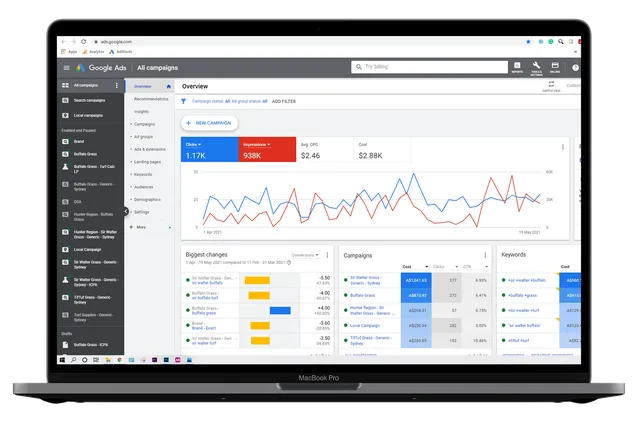



Measuring Google Ads Conversions: From Clicks to Business Decisions


In Google Ads, clicks are often the most visible metric, but they do not say much about business performance on their own. An ad may attract a great deal of traffic without generating calls, sign-ups, or orders. Conversely, an ad group with modest traffic may still bring in the right customers. Therefore, the important question is not only how many clicks an ad receives, but also whether those clicks lead to valuable actions.
Conversion measurement is the way to connect advertising activity with specific results on a website or within the sales process. When set up properly, the system can record actions such as submitting a contact form, making a phone call, completing a payment, booking a consultation, or downloading a document. This gives businesses a basis for evaluating campaigns, comparing lead quality, and allocating budgets more deliberately.
A conversion is not always an order
The concept of a conversion needs to be defined according to the business model. For an online store, the primary conversion may be a completed transaction. For a service provider, submitting a form or making a phone call may be the first step toward a sales opportunity. A software website may consider signing up for a trial a conversion, while a consulting firm may be interested in requests for a quote.
The key point is that not every interaction should be treated as having equal value. Page views, time spent on a website, or scrolling activity may help explain user behavior, but they do not necessarily reflect purchase intent. These actions can be tracked as reference indicators, but businesses should clearly distinguish between primary and secondary conversions.
Primary conversions are typically used to evaluate business objectives and support bid optimization decisions. Secondary conversions serve to analyze the customer journey or understand the level of engagement. If too many unimportant actions are included in the same optimization goal, the data may become noisy. The system may then direct the budget toward interactions that are easy to achieve but do not generate corresponding revenue.
Points to align on before implementation
Before creating tags or connecting tools, businesses should make a short list of the actions they want to measure. This list should answer three questions: Which actions show that users are genuinely interested? Which actions can be verified? And which actions are directly related to revenue or sales opportunities?
For example, a website may need to track contact forms, phone-call buttons, messaging buttons, appointment bookings, and completed transactions. Each action should have an easy-to-understand name, a clear description of the recording conditions, and an assigned person responsible for checking it. If multiple departments use the data, consistent naming will help prevent confusion between a consultation form and a newsletter sign-up form.
Businesses also need to decide how to distinguish between conversions with different levels of value. A request for a quote may be more important than a document download. A paid order may need to be recorded differently from adding a product to a cart. Establishing priorities from the outset helps advertising reports more closely reflect actual objectives.
Common methods for recording conversions
For actions that occur on a website, businesses can use tracking tags or connect data to an analytics tool. The specific implementation depends on the website platform, form structure, and event-processing workflow. The important thing is that an event should be sent only when the action has actually been completed, rather than being triggered merely when a user clicks a button without successfully submitting anything.
For forms, a reliable recording point is usually a confirmation page or an event that appears only after the system returns a successful-submission status. If tracking occurs immediately when the submit button is clicked, a person may be counted as a conversion even though the form is incomplete, an error has occurred, or another verification step has blocked the submission.
For phone calls, measurement needs to consider the call source and whether the call can be identified as having originated from an ad. Clicking a phone number on a mobile device does not necessarily mean that an actual conversation took place. Businesses should establish internal criteria for assessing call quality, such as whether the call connected and was handled by an employee according to the established process.
For e-commerce, conversion data should reflect completed transactions and order value whenever possible. Recording only product views or add-to-cart actions helps analyze the funnel, but should not replace purchase data. If the sales system allows it, transmitting transaction value will support a more accurate assessment of revenue performance than simply counting the number of conversions.
Check the data before using it for optimization
Completing the setup does not mean that the system is working correctly. The testing stage should be conducted using real-world scenarios on the website. The person responsible can open the landing page, complete a test form, check the thank-you page, or carry out the purchase process in an appropriate environment. Afterward, they need to verify whether the event was sent at the right time and exactly once.
A common error is double-counting conversions. This can happen when the same action is recorded by multiple tags, when a user reloads the confirmation page, or when the advertising tool and analytics tool are both included in reports without clear conventions. Double-counted data makes the cost per conversion appear lower than it really is and causes campaign evaluations to become inaccurate.
Another error is recording conversions from actions that were not completed. For example, an event may be triggered when a user sees a form rather than submits it, or when a button is clicked even though the system has not confirmed the request. Small discrepancies can accumulate over time, particularly when a business uses that data to compare ad groups or adjust budgets.
The testing process should be repeated after major changes to the website, such as replacing a form, changing the payment platform, updating tracking code, or editing the confirmation page. Recording the test date, the person who performed it, and the result will help identify the cause when metrics fluctuate unusually.
Read reports based on quality rather than quantity alone
The number of conversions is a starting point, not the final conclusion. Businesses need to consider this metric alongside advertising costs, order value, qualified-customer rate, and results from the sales team. A campaign that generates many forms but whose submissions are mostly unreachable may be less effective than a campaign that generates fewer forms but has a high closing rate.
For services with long sales cycles, business results often do not appear immediately in advertising reports. In that case, there needs to be a process for connecting data from forms or calls with processing statuses in the sales system. Statuses such as contacted, qualified, quote sent, or contract signed help businesses see the gap between online conversions and final outcomes.
Businesses should not rush to conclusions based on only a short period or a single change. Data needs to be viewed in the context of budget, seasonality, product quality, response time, and customer-handling capacity. Google Ads is only one part of the journey. If employees respond slowly or the form is difficult to use, increasing the budget may not solve the problem.
Privacy and transparency in measurement
Conversion measurement needs to go hand in hand with respect for privacy and the legal requirements applicable to the website. Businesses should provide appropriate notice about the use of tracking technologies, manage data only to the extent necessary, and avoid collecting information that does not serve a clear purpose. Customer data should also be subject to controls over access rights, retention periods, and internal use.
Sensitive information or content that directly identifies customers should not be included in URL parameters, event names, or data sent to advertising platforms. Naming conversions according to business actions, rather than including personal information, makes reports easier to manage while also reducing unnecessary risk.
Turn measurement into an ongoing process
An effective measurement system is not something that can be installed once and then forgotten. Websites, forms, sales processes, and business objectives can all change. Therefore, businesses should schedule regular reviews to determine whether conversions are still relevant, whether data is being double-counted, and whether the actions marked as primary truly reflect business value.
A good report does more than show which ads have cheaper clicks. It should support practical questions: Where do high-quality customers come from? Which step in the journey is causing losses? Which costs are acceptable? And what evidence should guide budget adjustments? When marketing, sales, and website management agree on these questions, Google Ads data becomes a decision-making tool rather than just a table of figures.
Accurate conversion measurement helps businesses see what matters beyond the click. From identifying valuable actions and establishing how they are recorded, to checking the data and comparing it with sales results, each step helps clarify the true effectiveness of advertising. When the data foundation is reliable enough, budget optimization can be based on opportunity quality and business results instead of merely chasing surface-level metrics.